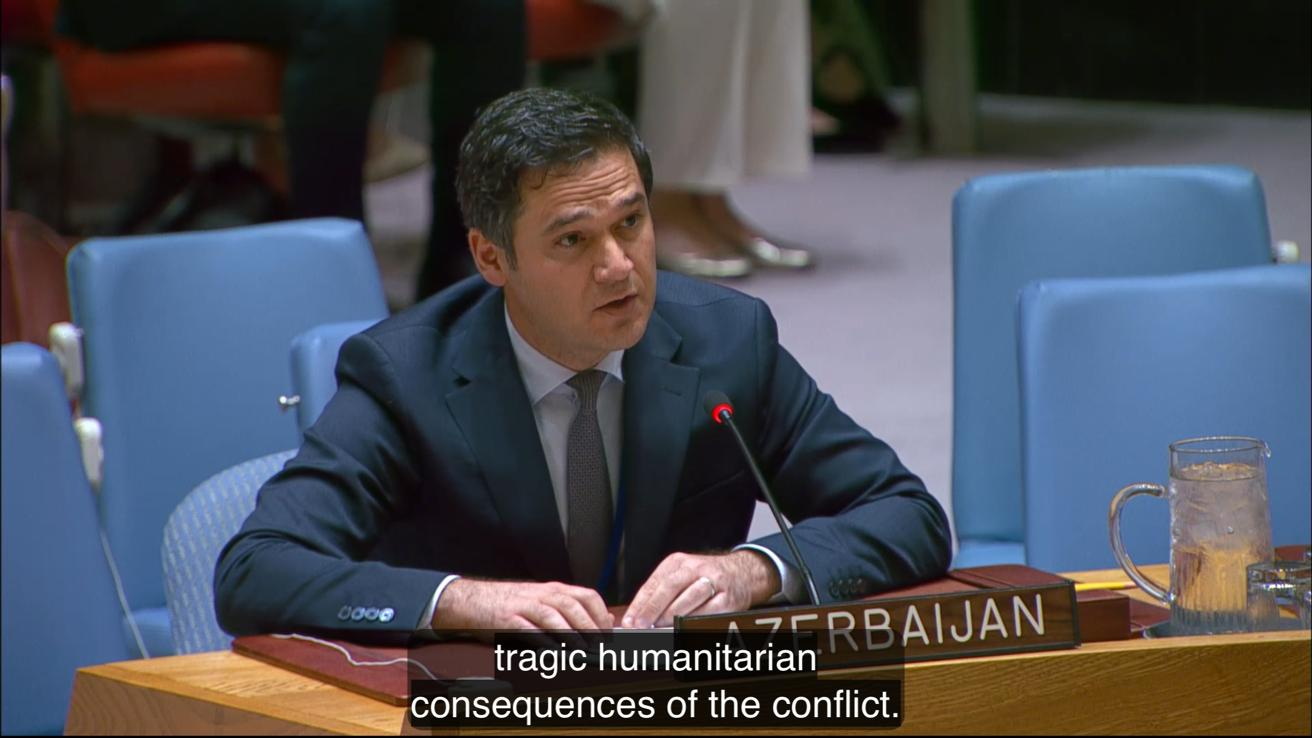
Statement by Mr. Elvin Ashrafzade, Chargé d'affaires, Deputy Permanent Representative of the Republic of Azerbaijan to the United Nations, at the open debate of the Security Council on the theme “Protection of Civilians in Armed Conflict”, 20 May 2026
|
Azərbaycan Respublikasının |
 |
Permanent Mission |
|
633 Third Avenue, Suite 3210, New York, N.Y. 10017 |
||
|
Statement by Mr. Elvin Ashrafzade Chargé d'affaires, Deputy Permanent Representative of the Republic of Azerbaijan to the United Nations at the open debate of the Security Council on the theme “Protection of Civilians in Armed Conflict”
Security Council Chamber, UNHQ, 20 May 2026
Mr. President,
I would like to begin by conveying our gratitude to the delegation of the People's Republic of China for convening this important meeting.
Regrettably, armed conflicts continue to have devastating consequences for civilians worldwide, disproportionately affecting women, children, persons with disabilities, and others in vulnerable situations. This underscores the urgent need for the strict and consistent implementation of international humanitarian law, complemented by international human rights law.
As 2026 marks the 10th anniversary of Security Council resolution 2286 (2016), this debate offers an important opportunity to review its implementation. In addition, in the Pact for the Future, Member States committed to taking concrete and practical measures in response to the grave impact of armed conflict on civilians.
However, persistent non-compliance with international obligations and the lack of accountability for violations of international humanitarian and human rights law remain serious challenges, including in post-conflict settings.
Mr. President,
The Security Council, in its resolution 2474 (2019), acknowledged that full and timely support for humanitarian components can be critical in ensuring and enhancing the sustainability of post-conflict peacebuilding.
Despite the end of the decades-long conflict and the progress achieved in advancing the peace agenda in the region, Azerbaijan continues to suffer from the tragic humanitarian consequences of the conflict. The fate and whereabouts of nearly four thousand Azerbaijani nationals (3,999), including 71 minors, 287 women, and 319 elderly persons, remain unknown.
In several cases, whole families went missing, resulting in the disappearance of entire family lines. Some individuals disappeared even after being visited in custody by the International Committee of the Red Cross. Since the end of the occupation and conflict, 32 mass graves have been found, containing the remains of 253 individuals. These findings point to the deliberate killing of civilians and other protected persons under international humanitarian law. The fate of most missing persons remains unresolved.
Aiming to contribute to international efforts on missing persons, Azerbaijan has organized international conferences, in particular, a dedicated platform of the Baku Dialogue on Missing Persons. The Declaration of the Baku Dialogue on Missing Persons of 2025, has also been circulated as an official document of the Security Council (S/2025/797). Furthermore, in line with the General Assembly resolutions on missing persons (77/220 of 15 December 2022 and 79/173 of 17 December 2024), initiated by Azerbaijan, the first-ever General Assembly meeting on missing persons was convened on 2 April 2025.
Another pressing humanitarian consequence of the conflict is the extensive mine contamination of the territories of Azerbaijan, which seriously hinders the safe and dignified return of displaced populations, as well as post-conflict recovery and reconstruction.
The number of post-conflict mine victims in Azerbaijan is rising and has reached 425 since November 2020, of whom 73 lost their lives and 352 suffered horrific injuries, most of them civilians. The scale and magnitude of the landmine threat in Azerbaijan necessitate enhanced accountability, stronger solidarity and partnership, and adequate international assistance for national humanitarian demining capability and efforts.
Furthermore, Azerbaijan is rebuilding the cities and towns destroyed during the occupation. As a result of the reconstruction and rehabilitation measures undertaken, around 85,000 people have been resettled and are now living and working in newly built cities and towns. The hosting of the ongoing 13th session of the World Urban Forum further demonstrates Azerbaijan’s vision for transforming the liberated territories into models of modern and sustainable urban development.
Mr. President,
States are under an obligation not only to prevent, but also to ensure accountability for the most serious violations. Azerbaijan has taken decisive steps to investigate and prosecute numerous atrocity crimes committed during the conflict, in full accordance with its national legislation and obligations under international law.
In conclusion, Azerbaijan reaffirms its unwavering commitment to international humanitarian and human rights law and its continued efforts to advance the Protection of Civilians agenda and mitigate the impact of armed conflict on vulnerable populations.
Thank you. |
||